150 Dark Journal Prompts KDP Interiors: Thoughtful, Editable Tools for Deep Creative Work
Journaling has evolved far beyond simple daily entries. Today’s creators, therapists, writers, and self-directed learners are seeking tools that support emotional honesty, psychological nuance, and aesthetic intentionality—all without sacrificing practicality. That’s where 150 Dark Journal Prompts KDP Interiors stands apart: a purpose-built interior template set designed not just for reflection, but for resonance. Each of the 150 prompts is thoughtfully grouped into ten thematic categories—Self-Reflection Shadow Work, Pain and Trauma from the Past, Macabre Horror Themes, Death and the Afterlife, Existential Dread and Reality Distortion, Forbidden Thoughts and Hidden Desires, The Unknown and Unexplainable, Doppelgängers and Identity Horror, Time and Reality Distortion, and Psychological Descent or Madness. These aren’t surface-level questions. They’re invitations to explore layers of inner experience with clarity, safety, and stylistic control.
Why “Dark” Journaling Is Gaining Ground—Without the Stigma
The term “dark” here isn’t about despair or pathology—it’s about depth. In a cultural moment increasingly attuned to mental wellness, authenticity, and narrative complexity, people are moving past performative positivity. Therapists integrate shadow work into clinical practice; writers use horror tropes to externalize internal conflict; educators encourage critical self-inquiry in creative writing courses. This shift reflects broader habits: digital fatigue has made analog, tactile practices like journaling more valuable—not as escape, but as grounding. At the same time, audiences expect personalization. A static PDF no longer meets expectations. Users want agency over tone, pacing, and visual language—and that’s precisely what the Canva-editable format delivers.
Edit With Purpose—Not Just Convenience
Each page in the 150 Dark Journal Prompts KDP Interiors set arrives as a fully editable Canva file. That means you’re not limited to swapping out text. You can adjust fonts to match a gothic serif for macabre themes—or switch to a clean, minimalist sans-serif when exploring existential questions. Colors can deepen mood (charcoal grays, deep indigo, blood crimson) or soften intensity (muted slate, parchment beige). Layouts can be restructured: add breathing space before a heavy prompt about trauma; tighten margins for a rapid-fire series on identity distortion. Even the intro page invites customization—so your journal begins with your voice, not a generic header. This level of control supports real workflow integration. A freelance writer might adapt prompts for character development; a counselor could tailor one section for client handouts; a content creator might remix layouts for Instagram carousels or Patreon exclusives.
Designed for Real Publishing—Not Just Drafting
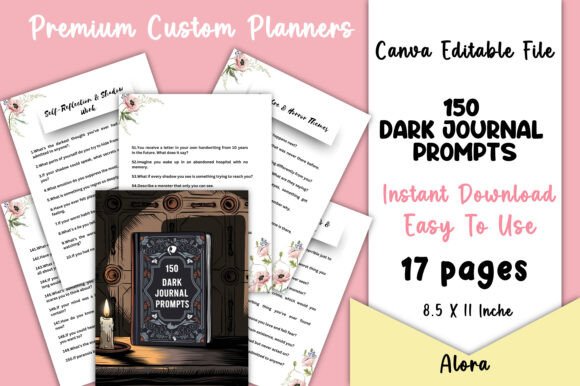
KDP interiors require precision: correct dimensions (8.5″ x 11″), proper bleed and margin settings, print-ready contrast, and consistent pagination. These 17 pages—including an intro page—are KDP-tested. That means no last-minute formatting surprises, no rejected uploads due to spacing errors or RGB color mismatches. The included PDF is optimized for immediate upload, while the Canva file preserves full editability for future iterations. For creators building multiple journals—or launching a themed series—this dual-format approach saves hours. You maintain creative flexibility *and* publishing reliability. No need to choose between expressive design and technical compliance.
How These Prompts Fit Modern Creative & Professional Needs
Consider how these prompts operate in context:
- A marketer developing a brand voice around authenticity might use the “Forbidden Thoughts and Hidden Desires” section to uncover unspoken audience tensions—then translate those insights into empathetic messaging.
- An educator teaching speculative fiction could assign the “Doppelgängers and Identity Horror” prompts to spark essays on self-perception, social media personas, or cultural mimicry.
- A small business owner navigating burnout might turn to “Psychological Descent and Madness” prompts—not to dwell in crisis, but to map early warning signs, recognize cognitive distortions, and reclaim agency through structured reflection.
- A blogger documenting a healing journey could adapt “Pain, Trauma, and the Past” prompts into weekly posts—each illustrated with customized layouts that evolve visually alongside their emotional arc.
This isn’t about filling pages. It’s about creating containers for meaning—ones that respect both the weight of the subject matter and the user’s right to shape their experience.
From Trend to Tool: What’s Changed in Journal Design?
Five years ago, most printable journal interiors followed predictable templates: lined pages, basic headers, minimal visual distinction between sections. Today, users expect cohesion across theme, typography, and function. The rise of Canva as a professional-grade design tool—paired with growing comfort among non-designers using layers, grids, and brand kits—has shifted expectations. People don’t just want prompts; they want prompts that feel intentional, immersive, and aligned with their values. The “dark” aesthetic, when handled with care, signals seriousness, curiosity, and psychological safety—not shock value. That’s why this collection avoids cliché imagery (no gratuitous skulls or blood splatters) and focuses instead on evocative typography, restrained palettes, and whitespace that invites pause.
Practical Tips for Getting Started
You don’t need to begin at prompt #1—or even use all 150. Try these grounded approaches:
- Start with your current energy. If you’re feeling restless, skip ahead to “Time and Reality Distortion.” If you’re in a period of transition, “Doppelgängers and Identity Horror” may resonate more than “Death and the Afterlife.”
- Use the Canva file iteratively. Duplicate a page, change the font and background, then save it as a new version. Over time, you’ll build a personal style library for different moods or projects.
- Print selectively. Not every prompt needs paper. Choose 3–5 per week, bind them into a slim chapbook, or paste them into a physical notebook beside sketches or quotes.
- Share thoughtfully. When you post your adapted journal pages online—whether on Instagram, Pinterest, or a blog—credit the original interior and tag the creator. This supports ethical reuse and helps others discover tools built with integrity.
Remember: the goal isn’t completion. It’s engagement. A prompt that stirs discomfort, lingers in memory, or sparks unexpected connection has already done its work—even if you write only two sentences in response.
What’s Included—And Why It Matters
The package includes:
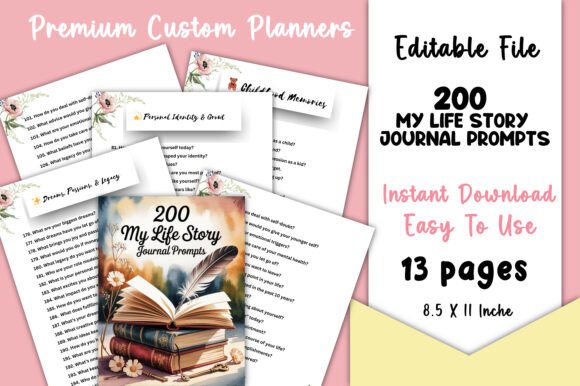
- 17 total pages (1 intro + 16 prompt pages), sized precisely for KDP’s 8.5″ x 11″ standard
- A Canva-editable file—fully layered, with editable text boxes, color swatches, and layout elements
- A print-optimized PDF—ready for immediate upload, with correct CMYK settings and embedded fonts
- Thematic grouping that supports intuitive navigation—not random assortment
This isn’t filler content disguised as utility. Every prompt was written to avoid vagueness (“What are you feeling?”) and cliché (“List three things you’re grateful for”). Instead, they invite specificity, ambiguity where appropriate, and room for silence. The design follows the same principle: functional, flexible, and respectful of the user’s time and attention.
If you’ve ever hesitated to start a journal because the format felt too rigid—or too shallow—or if you’ve spent hours tweaking margins and fonts just to get one page right, this interior offers something rare: structure that serves depth, not constrains it. It’s ready when you are—whether you’re preparing your first KDP launch, supporting clients through complex emotional work, or simply making space to ask harder questions in softer light.