Workout Journal – KDP Interiors
Staying consistent with fitness isn’t just about showing up—it’s about showing up with intention. That’s where the Workout Journal – KDP Interiors steps in: not as another generic notebook, but as a thoughtfully structured 120-page companion designed to turn scattered effort into measurable, meaningful progress. Whether you're lacing up for your first gym session or fine-tuning an elite training cycle, this journal meets you where you are—and helps you move forward with clarity and confidence.
More Than Just Lines and Boxes
At its core, the Workout Journal – KDP Interiors is built on behavioral science principles—small, repeatable actions that compound over time. It doesn’t assume you already know how to set goals or interpret fatigue cues. Instead, it scaffolds reflection, planning, and tracking so those habits form naturally. Think of it less like a logbook and more like a personal trainer bound in matte-finish paper: supportive, structured, and quietly encouraging.
Goal Setting That Sticks
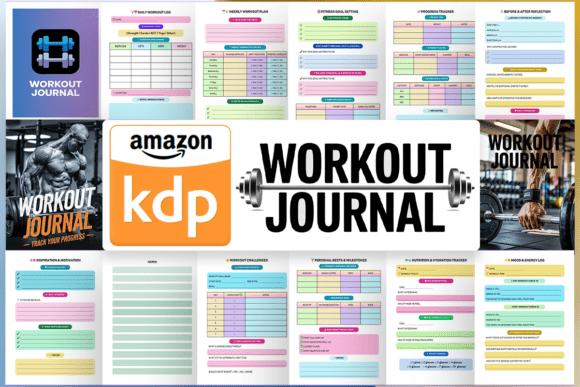
The journal begins with dedicated Fitness Goal Setting Pages—not vague affirmations like “get fit,” but guided prompts that help you define your why, map short-term wins (e.g., “complete 3 full-body sessions this week”), and outline long-term visions (e.g., “run a 5K without stopping by October”). This section works because it separates aspiration from action: you’re asked to name one obstacle—and one resource—you already have. That simple duality grounds ambition in reality.
Daily Logs That Capture Nuance
Each Daily Workout Log offers space for exercises, sets, reps, weights, cardio duration, and mobility work—but also includes room for notes on modifications, form cues, or even how a particular movement felt. A beginner might write, *“Squats: 3x8 @ 45 lbs—knees caved slightly on last set; tried cueing ‘spread the floor’ next time.”* An experienced lifter might note, *“Deadlift PR: 275 lbs × 1—grip failed before lockout; switching to mixed grip next cycle.”* Both entries become data points—not just records, but learning moments.
Mood & Energy: The Often-Ignored Metrics
Before and after each session, the journal invites a quick Mood Energy Check-In. You’re not rating yourself—you’re observing. A low-energy Tuesday might pair with solid focus, while a high-energy Friday could coincide with poor sleep and shaky form. Over time, patterns emerge: maybe hydration dips correlate with afternoon slumps, or morning meditation lifts workout consistency by 22%. These insights don’t come from apps—they come from quiet, consistent self-attention.
Tracking That Tells a Story
The Workout Journal – KDP Interiors avoids overwhelming charts. Its Progress Tracker uses clean, visual-friendly layouts—think shaded bars for strength gains, checkboxes for endurance milestones, and simple date-stamped lines for weight trends. No need to calculate percentages or convert units. If you added 5 lbs to your bench press on March 12? You circle it. If your plank held steady at 2:15 for three weeks straight? You mark the streak. Progress becomes tangible—not abstract.
Nutrition & Hydration: Context, Not Control
The Nutrition Hydration Tracker skips calorie counting and macro math. Instead, it asks: *What did I eat before my workout? How did it fuel me? What did I drink after? Did I feel recovered by tomorrow?* A busy teacher might log oatmeal + banana pre-class and notice sharper focus during HIIT. A shift worker might discover that skipping dinner before evening lifting leads to dizziness—not a flaw, just useful intel. This section supports awareness, not restriction.
Before & After Reflection: Beyond the Scale
Every few weeks, the Before After Reflection prompts invite deeper inquiry: *What’s easier now than it was two months ago? What mental habit shifted? When did I choose rest over guilt?* One user wrote, *“I used to dread leg day. Now I look forward to the burn—not because it’s fun, but because I trust my body to adapt.”* That kind of insight rarely appears in spreadsheets. It lives here.
Who Benefits—and How
The Workout Journal – KDP Interiors serves diverse needs:
- Gym newcomers gain scaffolding—no guesswork about what to track or how to start.
- Home exercisers use the Weekly Workout Planner to schedule bodyweight circuits, yoga flows, or resistance band days—even without equipment.
- Athletes & coaches repurpose the Personal Bests Milestones page to benchmark sport-specific feats: fastest 40-yard sprint, cleanest snatch technique, longest breath-hold during swim drills.
- Rehab patients find gentle structure: logging pain levels, range-of-motion improvements, or walking distance alongside physical therapist notes.
It’s also a quiet tool for neurodivergent users—its predictable layout reduces decision fatigue, while handwritten entries support sensory grounding better than blinking screens.
Real-World Use Cases
Consider Maria, a nurse working 12-hour shifts. She uses the Weekly Workout Planner every Sunday night—not to force rigid schedules, but to block “movement windows”: 15 minutes of stretching post-shift, a 20-minute walk during lunch, one strength session on her day off. She doesn’t aim for perfection. She aims for presence—and the journal holds that space.
Then there’s James, training for his first powerlifting meet. He fills the Daily Workout Logs with technical notes (“Paused bench: 3x5 @ 225—bar path wobbled on rep 4”) and uses the Progress Tracker to compare squat velocity across mesocycles. His coach reviews scanned pages—not to critique, but to spot subtle fatigue signals he missed.
Strengths, Realities, and Smart Fit
Its greatest strength? Accessibility. No subscription. No battery. No syncing. Just pen, page, and presence. It also resists the “all-or-nothing” trap—if you miss three days, the next page is still blank and waiting, judgment-free.
That said, it’s not for everyone. If you rely on auto-calculated macros or live in a fully digital ecosystem (Apple Health, Garmin, MyFitnessPal), the manual entry may feel redundant. And while the journal encourages reflection, it won’t diagnose injury or replace medical advice—its role is documentation, not diagnosis.
To evaluate fit, ask yourself:
- Do I often forget what I did last session—or why I chose it?
- Do I want to see how energy, sleep, or stress impact performance—not just reps and weight?
- Would a physical artifact—a book I can flip through, highlight, or dog-ear—feel more motivating than an app notification?
If two or more resonate, the Workout Journal – KDP Interiors is likely worth trying—not as a fix, but as a lens.
Final Thought: Your Journey, Documented
Fitness isn’t linear. Some weeks bring breakthroughs. Others bring plateaus, setbacks, or quiet recalibration. The Workout Journal – KDP Interiors doesn’t promise transformation. It offers something quieter, and more powerful: continuity. Page after page, it says, *You showed up. You tried. You learned. You kept going.* And over time, that consistency—the unglamorous, handwritten, deeply human act of tracking your own growth—becomes the foundation everything else rests on.