Digital Detox Journal – KDP Interiors: A Strategic Tool for Intentional Living and Sustainable Focus
For professionals who manage multiple platforms, launch campaigns, mentor teams, or juggle client work while building personal brands, attention isn’t just scarce—it’s the most contested resource in your operating system. The Digital Detox Journal – KDP Interiors isn’t another self-help trend. It’s a deliberately structured, 120-page operational framework designed to help adults aged 20–50 reclaim cognitive bandwidth—not as a retreat from responsibility, but as a recalibration of how they allocate energy, make decisions, and sustain creative output over time.
Why This Journal Fits Into Real Workflows—Not Just Wellness Routines
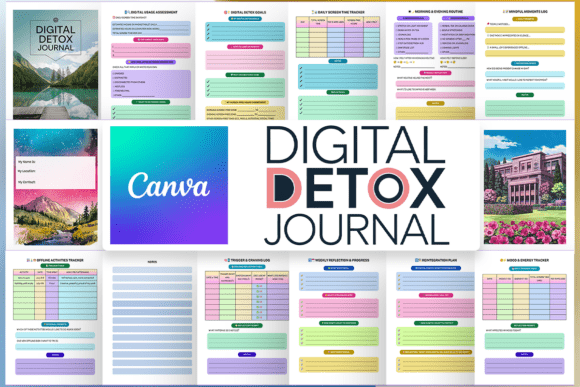
Unlike generic reflection journals, the Digital Detox Journal – KDP Interiors embeds behavioral awareness into daily practice through tactical prompts—not abstract affirmations. Consider how its Daily Screen Time Logs function: they don’t just ask “How much time did you spend online?” They prompt you to note which app triggered fatigue, which notification interrupted deep work, and whether that scroll happened before a high-stakes call or after a rejected proposal. That specificity transforms passive habit tracking into diagnostic data. A freelance copywriter notices their Instagram usage spikes after client feedback arrives—revealing an emotional regulation gap, not just a time management one.
Similarly, the Distraction Log surfaces patterns that analytics dashboards miss: the difference between researching a new tool (purposeful) and refreshing email every 90 seconds (reactive). When used consistently for two weeks, this log often uncovers *contextual triggers*—like checking Slack during quiet hours because team expectations around responsiveness haven’t been clarified. That insight feeds directly into boundary-setting conversations, not just personal discipline.
Strategic Use Cases Across Roles
The value of the Digital Detox Journal – KDP Interiors shifts meaningfully depending on your role—and that’s by design.
- For educators and course creators: The Morning & Evening Prompts support pedagogical intentionality. One university lecturer uses the “What do I want my students to feel today?” prompt to align lecture design with emotional outcomes—not just content coverage. That small shift improved engagement metrics more than adding slides or videos.
- For small business owners: The Offline Activity Tracker becomes a low-risk innovation lab. Instead of launching a new service based on competitor moves, they log three offline experiments per week—e.g., sketching product ideas on paper, interviewing customers face-to-face, prototyping packaging with physical materials. These entries later inform positioning decisions with tangible evidence, not assumptions.
- For marketers and content strategists: The Weekly Reflections expose misalignment between stated goals and actual behavior. One SaaS marketer discovered 68% of her “strategic planning” time was spent reacting to platform algorithm changes—prompting her to renegotiate quarterly OKRs with leadership and build buffer time for long-term thinking.
When—and How—to Engage With Intention
This journal works best when treated as a *decision-support tool*, not a compliance exercise. Its power emerges only when paired with clear objectives. Before opening it for the first time, ask yourself: What specific outcome am I trying to influence? Examples include:
- Reducing decision fatigue before noon so I can prioritize client strategy over inbox triage
- Creating space to prototype a new workshop format without digital distraction
- Improving sleep quality to sustain consistent creative output across projects
- Clarifying which digital channels actually drive qualified leads—not just vanity metrics
Without anchoring to such outcomes, the Digital Detox Journal – KDP Interiors risks becoming ritual without return—pages filled, insights unapplied. Start narrow: pick *one* section (e.g., Wellness Check-Ins) and commit to using it for five days with one measurable aim (“I will pause before replying to non-urgent messages”). Observe what shifts—not just in screen time, but in response latency, clarity of next steps, or confidence in saying no.
Risks of Using It Without Context
A journal can’t fix systemic issues—and treating it like a silver bullet introduces real risk. If your team expects real-time replies across six apps, logging your scrolling won’t resolve the underlying expectation mismatch. Similarly, if your revenue model depends on constant social visibility, eliminating Instagram entirely may undermine business viability—even if it improves mental clarity. The Digital Detox Journal – KDP Interiors reveals friction points; it doesn’t eliminate them. Its value lies in helping you distinguish between habits worth changing and systems requiring negotiation or redesign.
Another common pitfall: conflating reduced screen time with increased productivity. One brand consultant logged 40% less device use—but her output dropped because she hadn’t replaced digital research with equally efficient offline alternatives. The journal surfaced the gap; the solution required designing a hybrid workflow (e.g., 30-minute focused web research blocks followed by analog synthesis). That nuance is why the Mindfulness Moments prompts emphasize *presence*, not just absence—they prepare you to engage deeply with whatever replaces the screen.
Building Long-Term Capacity, Not Short-Term Fixes
The Digital Detox Journal – KDP Interiors supports long-term resilience by reinforcing metacognition—the ability to observe your own thinking. Over time, users report stronger pattern recognition: spotting early signs of burnout before they escalate, identifying which meetings drain versus energize based on pre- and post-session reflections, or recognizing when “research” has crossed into avoidance.
This isn’t about achieving permanent disconnection. It’s about developing fluency in switching modes—knowing when to dive deep into code or curriculum design, when to step back and walk without audio input, and when to re-engage with tools *on your terms*. That fluency compounds: a blogger who uses the Digital Detox Journal – KDP Interiors to audit her newsletter writing process discovers her best ideas emerge during offline walks. She begins scheduling those walks *before* drafting—not as breaks, but as core parts of her ideation system.
Practical Integration Tips
You don’t need to overhaul your routine to benefit. Try these grounded approaches:
- Anchor it to existing habits: Keep the journal beside your morning coffee mug or next to your laptop at shutdown time—not buried in a drawer.
- Use it to test assumptions: If you believe “checking email first thing helps me prioritize,” log your mood, focus, and actual priority alignment for five days. Let the data—not the belief—guide your next move.
- Leverage the Offline Activity Tracker for skill-building: Commit to trying one new offline activity weekly (e.g., hand-lettering notes, cooking without video guidance, mapping a neighborhood on foot). These aren’t distractions—they’re neural cross-training that strengthens divergent thinking.
- Review weekly—not daily: Daily logs build awareness; weekly reflections build strategy. Block 20 minutes each Sunday to scan trends, then adjust one behavior for the coming week.
The Digital Detox Journal – KDP Interiors succeeds not because it eliminates complexity, but because it gives structure to navigating it. In a world where attention is auctioned, monetized, and fragmented, choosing where to place yours—deliberately, repeatedly, and with evidence—isn’t wellness. It’s strategy. And strategy, when practiced with this level of granularity and honesty, compounds quietly but decisively across months and years.