Thought Processing Canva KDP Interiors: A Strategic Tool for Intentional Thinking and Business Clarity
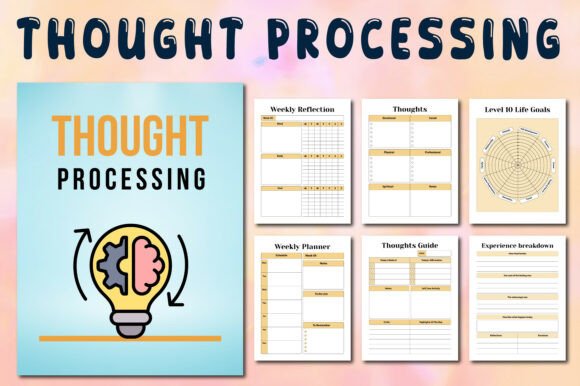
Thought Processing Canva KDP Interiors isn’t just another printable planner—it’s a precision-crafted system designed for professionals who treat mental clarity as operational infrastructure. At its core, it’s a 31-page, fully editable Canva template suite built for depth, consistency, and real-world application. Every page serves a distinct cognitive or organizational function: from Anxiety Breakdown and Reaction Journey Experience Breakdown to Daily Positive Thoughts, Weekly Wellness Anxiety Log, and Level 10 Life Goals Thoughts. You receive high-resolution, print-ready PDF, JPG, and PNG files—8.5 x 11 inches, 300 DPI, no bleed—plus a live, editable Canva link. All 100 customizable original files are yours to adapt, brand, scale, or repurpose without licensing friction.
Why Thought Processing Canva KDP Interiors Fits Real Business Strategy
Most planning tools assume you need more structure. Thought Processing Canva KDP Interiors assumes you need better *sense-making*. Entrepreneurs, educators, freelancers, and small business owners often operate in ambiguity—not from lack of effort, but from unprocessed input: client feedback, market shifts, internal doubts, creative blocks, or emotional fatigue. This resource doesn’t ask you to “get organized.” It invites you to map your thinking with fidelity. That distinction matters. When your Thoughts Daily Thoughts List becomes a diagnostic tool—not just a journal—you begin spotting patterns in decision fatigue. When your Meditation Log aligns with your Weekly Reflection, you see how recovery time impacts execution quality. That’s not self-help. That’s systems-level awareness.
Strategic Use Cases Across Roles
How you apply Thought Processing Canva KDP Interiors depends on your role—and your current leverage point:
- For creators and bloggers: Use the Feelings Inventory and My Happy Place pages before drafting content. Not to “feel good,” but to identify emotional resonance gaps between what you’re producing and what your audience actually needs. Pair this with the Daily Gratitude Note to calibrate tone and authenticity over time.
- For educators and coaches: Adapt the Thoughts Guide and Daily Reflection into student-facing prompts—or use them privately to audit your own instructional assumptions. The Experience Breakdown page helps surface unconscious biases in lesson delivery or feedback patterns.
- For solopreneurs and small business owners: Run weekly reviews using Weekly Planner + Weekly Reflection + Monthly Thoughts as a triad. This isn’t about tracking hours—it’s about tracing how shifting priorities (e.g., “I thought pricing was the issue, but the Anxiety Log shows my hesitation stems from imposter signals around authority”) inform real operational pivots.
- For marketers and product teams: Repurpose This Book Belongs To and Thoughts Summarizing as lightweight customer empathy tools. Fill them out *as if you were your ideal client*—then compare with actual survey or interview data. Discrepancies reveal where messaging misses lived experience.
What Makes These Files Operationally Valuable—Not Just Aesthetic
The value of Thought Processing Canva KDP Interiors lies in its design integrity—not just its customization. Each file is built at 300 DPI, optimized for professional printing, with clean margins and no bleed. That means if you’re producing physical client workbooks, co-branded wellness kits, or limited-run journals for your community, you avoid last-minute formatting fires. The Canva link isn’t a static download—it’s a living workspace. Change fonts, colors, layouts, or add your logo in seconds. No design skills required. And because all 100 customizable original files are included—not just templates—you retain full ownership of derivatives. That’s critical for publishers building KDP interiors, educators creating licensable curriculum supplements, or agencies developing proprietary client onboarding tools.
When—and When Not—to Rely on Thought Processing Canva KDP Interiors
This system excels when used deliberately—not habitually. If your goal is simply “to journal more,” Thought Processing Canva KDP Interiors may overwhelm. Its power emerges when aligned with a specific outcome: reducing decision latency, improving client retention through deeper listening, increasing creative output consistency, or strengthening personal boundaries by mapping emotional triggers across weeks.
Conversely, it carries risk if treated as a substitute for action or accountability. Filling out the Daily Thoughts List daily won’t fix burnout—but reviewing it biweekly alongside your calendar *might* reveal that 70% of your reactive tasks cluster after 3 p.m., signaling a need to protect morning focus blocks. Similarly, the Gratitude Note only gains strategic weight when cross-referenced with your Weekly Planner: Are you expressing thanks for outcomes you actively engineered—or for things outside your control? That insight reshapes goal-setting.
Practical Integration Tips for Sustainable Use
Start narrow. Don’t open all 31 pages at once. Identify *one* recurring friction point this week—say, inconsistent follow-up with leads—and choose the single most relevant page: Thoughts Guide to clarify assumptions, Reaction Journey to unpack emotional resistance, or Daily Reflection to assess energy alignment. Complete it honestly. Then, next week, add one more page—only if it surfaces actionable insight.
Use version control. Duplicate your Canva file before major edits. Name versions meaningfully: “Thought-Processing-KDP-Interiors-Client-Onboarding-v2” or “Thought-Processing-KDP-Interiors-Team-Wellness-Q3.” This builds institutional memory—even in solo practice.
Print strategically. Not every page needs paper. Reserve high-quality prints for client-facing tools (e.g., the Meditation Log in a wellness package) or personal anchor points (e.g., the Level 10 Life Goals Thoughts page laminated beside your desk). Use digital versions for rapid iteration—especially the Daily Thoughts and Anxiety Log pages, where speed of capture matters more than permanence.
Long-Term Positioning: Beyond the Template
Thought Processing Canva KDP Interiors supports long-term positioning when treated as a foundational layer—not an end product. As your practice evolves, so can these files. Add industry-specific prompts to the Thoughts Daily Thoughts page. Embed your service framework into the Weekly Planner. Translate insights from the Experience Breakdown into case study narratives. Because everything is 100% customizable and original, you’re not adapting someone else’s logic—you’re extending your own intellectual property.
This matters for credibility. Clients and collaborators respond to coherence—not just competence. When your internal reflection system mirrors the clarity of your public messaging, your brand gains quiet authority. You don’t say “I help leaders think clearly.” You demonstrate it—through the rigor of your own Thoughts Summarizing practice, the consistency of your Weekly Reflection, the intentionality behind your My Happy Place definition. That alignment compounds over time.
Final Consideration: Clarity Is a Discipline, Not a Download
Thought Processing Canva KDP Interiors gives you structure—but discipline determines impact. The highest-performing users don’t fill pages daily. They return to the same three pages monthly, track subtle shifts, and let those observations inform quarterly strategy. They treat the Anxiety Breakdown not as catharsis, but as root-cause analysis. They use the Daily Positive Thoughts page not to suppress difficulty, but to test whether their affirmations align with measurable progress—not just mood.
If your goal is sharper decisions, fewer reactive pivots, and deeper alignment between your inner process and outer results, then Thought Processing Canva KDP Interiors offers more than convenience. It offers continuity. A way to build thinking muscle—not just document it. And in a world where attention is fragmented and outcomes are delayed, continuity is the quietest competitive advantage of all.