OCD Therapy Journal Canva KDP Interiors: A Thoughtfully Designed, Fully Customizable Tool for Real-World Recovery
Living with OCD means navigating a constant loop of intrusive thoughts, anxiety-driven urges, and time-consuming rituals—often in silence. What’s changed recently isn’t the condition itself, but how people seek support: quietly, intentionally, and on their own terms. That shift has fueled demand for tools that bridge clinical insight with everyday usability—and OCD Therapy Journal Canva KDP Interiors meets that need precisely. It’s not another generic planner or a static PDF workbook. It’s a high-quality, print-ready interior designed for Kindle Direct Publishing (KDP), yet equally effective as a personal therapeutic companion—whether you're preparing for therapy, supporting a loved one, or building long-term resilience outside formal care.
More Than a Journal—A Structured, Adaptable Framework for Self-Understanding
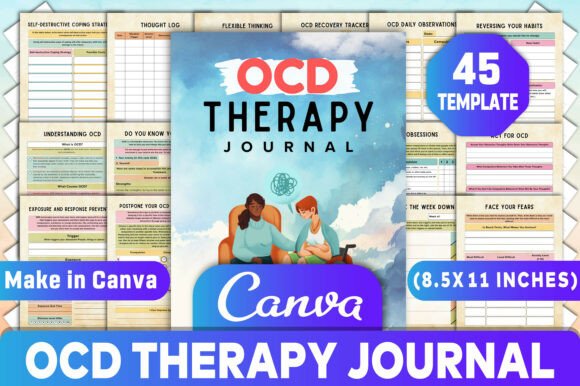
This isn’t about filling pages to “feel productive.” It’s about creating space where patterns become visible—and change becomes possible. The interior includes 40+ purpose-built sections grounded in evidence-based approaches: Exposure and Response Prevention (ERP), cognitive restructuring, thought logging, habit reversal, and stress tracking. Each page serves a distinct clinical function, from mapping your unique OCD cycle to identifying subtle triggers buried in daily routines. For example, the Your OCD Cycle spread helps users visually connect obsessions → anxiety → compulsions → temporary relief → renewed doubt—a critical first step before intervention. Meanwhile, Postpone Your OCD Compulsion offers a gentle, actionable alternative to suppression: delay, observe, reflect—not eliminate.
What sets this apart is its dual nature: it’s both professionally structured and deeply personal. Because every page is 100% customizable in Canva, you’re not locked into someone else’s language or layout. A therapist might rephrase prompts for a teen client; a freelancer could add time-blocking next to OCD Daily Observations; an educator might adapt Challenge Anxious Thoughts for classroom wellness workshops. You download editable Canva files (PDF, JPG, PNG), so adjustments happen in minutes—not hours.
Why Now? Aligning With How People Actually Manage Mental Health Today
People aren’t waiting for permission to prioritize mental wellness. They’re integrating it—quietly, consistently—into existing workflows. A marketing director logs intrusive thoughts between Zoom calls. A small-business owner tracks medication adherence alongside quarterly goals. A writer uses Therapy Progress Notes and Doctors Notes side-by-side to prepare for appointments without scrambling. This reflects broader shifts: rising telehealth use, growing comfort with self-guided tools, and increased awareness that recovery isn’t linear—it’s iterative, contextual, and highly individual.
The rise of creator-led mental health resources also matters. Unlike mass-produced journals, OCD Therapy Journal Canva KDP Interiors supports creators who want to publish ethically sourced, clinically informed work on Amazon. It gives them a polished, ready-to-upload interior—no design overhead, no guesswork around KDP formatting rules—while retaining full control over content tone, accessibility features, and branding. That flexibility responds directly to market needs: readers increasingly seek specificity (not generalizations), and creators need efficiency without compromising integrity.
Practical Use Cases Across Lifestyles and Roles
For individuals in therapy: Sections like Pre-therapy Prep, Therapy Goals, and Therapy Appointments turn passive attendance into active collaboration. Instead of summarizing last week’s session from memory, users bring annotated notes, tracked ERP attempts, and observed emotional shifts—making sessions more focused and outcomes more measurable.
For those managing symptoms independently: The OCD Recovery Tracker and Habit Tracker provide gentle accountability without rigidity. One user reported using Break the Week Down to schedule ERP exposures in 15-minute windows around childcare duties—proving structure doesn’t require perfection. Similarly, Listening to My Body and My Resilience Plan help users recognize early warning signs (e.g., jaw clenching, shallow breathing) before anxiety escalates—turning physiology into data, not just discomfort.
For educators and workplace wellness leads: Pages like Flexible Thinking and Strengths & Weaknesses can be excerpted into training materials. A university counseling center adapted Intrusive Thoughts and Self-destructive Coping Strategies into a workshop handout, pairing journaling with group reflection—reducing stigma while building shared language.
Design Integrity Meets Real-World Flexibility
Many mental health journals sacrifice clarity for aesthetics—or vice versa. This interior avoids both pitfalls. Typography is clean and legible at print size; spacing allows room for writing without crowding; visual hierarchy guides attention without dictating emotion. There are no forced affirmations or oversimplified prompts. Instead, questions invite honesty: What makes you anxious—today, specifically? or When did you last act *against* your compulsion, even briefly?
Customization isn’t just cosmetic. You can reorder sections to match your treatment phase—front-load Understanding OCD and Do You Know Your OCD early on, then shift to Face Your Fears and OCD Emotions as confidence grows. You can translate pages for bilingual households, add icons for neurodivergent users, or embed QR codes linking to ERP audio guides. The editable Canva file ensures these changes preserve professional print quality—no blurry text, misaligned margins, or KDP upload errors.
Supporting Sustainable Practice—Not Just Short-Term Fixes
Recovery from OCD isn’t measured in completed journals—it’s measured in reclaimed time, reduced avoidance, and increased tolerance for uncertainty. That’s why features like Stress Tracker, Self Care Plan, and Important Dates matter. They acknowledge that healing happens alongside life: job interviews, family obligations, creative deadlines. Tracking stress alongside compulsions reveals correlations—e.g., higher anxiety on days with back-to-back meetings—enabling proactive adjustments rather than reactive coping.
Similarly, Medication History and Doctor Visits reduce cognitive load during appointments. No more forgetting dosage changes or symptom fluctuations. And Your Goals to Combat OCD appears twice—not as repetition, but as evolution: the first version captures initial hopes; the second, written after six weeks, reflects nuanced priorities shaped by lived experience.
A Resource That Grows With You
What makes OCD Therapy Journal Canva KDP Interiors durable isn’t its completeness—it’s its openness. It doesn’t assume you’ll follow a prescribed path. It assumes you’ll learn, adjust, backtrack, and reinterpret. That’s reflected in pages like Reversing Your Habits, which invites reflection on what worked, what didn’t, and why—not as failure, but as data. Or Thought Log, which separates content (“I’m a bad person”) from function (“This thought shows my brain trying to protect me from uncertainty”).
Ultimately, this interior supports agency—not compliance. Whether you’re publishing on KDP, guiding clients, or turning quiet mornings into moments of clarity, it offers scaffolding—not scripts. It meets people where they are: tired, curious, cautious, hopeful, or somewhere in between. And because it’s built to adapt, it stays relevant across months, years, and phases of recovery—without needing replacement, revision, or reinvention.