Why Every Crochet Enthusiast Needs a Dedicated Crochet Journal — Especially This One
If you’ve ever dug through yarn scraps searching for that perfect shade, forgotten which hook worked best for your last lace shawl, or stared blankly at a half-finished project wondering where you left off—then you already know: crochet isn’t just about stitches. It’s about memory, momentum, and meaning. And Crochet Journal - KDP Interiors was built precisely for those quiet, real-world moments when inspiration meets intention.
A Tool That Grows With Your Craft
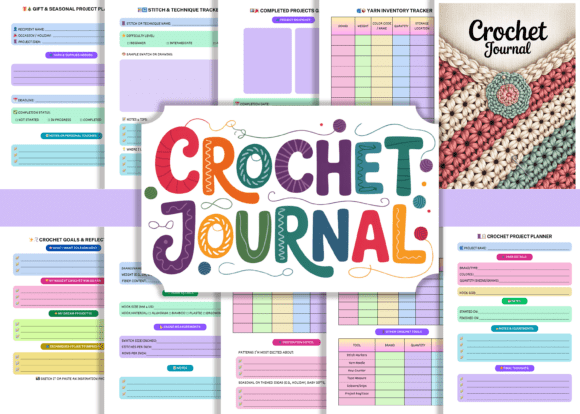
This isn’t a generic notebook with floral borders and a “Crochet Queen” sticker slapped on the cover. The Crochet Journal – Track Projects, Stay Inspired Stitch with Joy ✨🧵 is a thoughtfully engineered 120-page printable journal designed by makers, for makers. It bridges the gap between analog satisfaction and digital flexibility—print once, use endlessly, customize as your practice evolves.
Unlike free PDFs cobbled together from Pinterest pins—or rigid planners that force you into one workflow—it adapts. Whether you’re a beginner stitching your first granny square or a seasoned designer testing custom motifs, this journal meets you where you are. And because it’s printable, you control the paper weight, binding method (spiral? binder? handmade leather cover?), and even how many copies you make for seasonal themes or gift sets.
Project Planning Pages: From Idea to Finished Object—Without the Fog
We’ve all started projects brimming with energy… only to stall mid-scarf because we forgot our gauge, lost track of row count, or misplaced the pattern link. The Project Planning Pages solve that. Each spread includes dedicated lines for:
- Project name & photo space (yes—leave room for a Polaroid or sketch)
- Yarn details: brand, dye lot, weight, yardage used vs. remaining
- Hook size + notes (“Used 4.5mm Clover Amour—smooth but slipped on wet cotton”)
- Start/finish dates, plus optional “why I chose this” and “what I’d change next time” fields
That last bit—the reflection—is where growth happens. Over time, these pages become a personal archive of your development. Spot patterns in your preferences. Notice which yarns consistently frustrate you. See how your tension improves across seasons.
Your Stash, Sorted—Without the Spreadsheet Guilt
Let’s talk stash. Not the romanticized version—the cozy mountain of skeins glowing under fairy lights—but the *real* one: tangled, unlabeled, hiding behind the couch, or crammed into plastic bins with no memory of what’s inside.
The Yarn Inventory Tracker transforms chaos into clarity. Instead of scrolling through 47 tabs trying to recall if that teal Lion Brand Wool-Ease is DK or worsted, you log it once: brand, color name *and* number, fiber content, weight classification, quantity (in yards *and* grams), dye lot, purchase date, and—critically—where it lives. (“Top shelf, blue bin #3, behind the linen blend.”)
This isn’t just convenience. It prevents duplicate buys, supports sustainable crafting, and makes substitution decisions faster and more confident. Pair it with the Pattern Wishlist section, and suddenly your next project isn’t a shot in the dark—it’s a curated match of available materials, skill level, and mood.
More Than Hooks—It’s About Habits and Hardware
Your hooks do more than hold yarn—they hold muscle memory. A favorite aluminum F/5 might feel like an extension of your hand; a bamboo G/6 could be your go-to for summer wearables. But how often do you pause to note *why*?
The Hook Tool Inventory gives each tool its own profile: type (inline vs. tapered), material, size, ergonomic notes (“lightweight but slippery when hands sweat”), and even a “favorites” checkbox. You’ll spot gaps—like realizing you own five H/8s but zero tiny steel hooks for thread work—and identify wear-and-tear patterns before a beloved hook snaps mid-row.
Where Inspiration Meets Action
“I want to make something for spring.” “I love that textured stitch on Instagram.” “What if I combined filet and tapestry?”
Those sparks fade fast without capture. The Inspiration Pages aren’t vague mood boards—they’re grounded prompts: seasonal themes, color palettes you’re drawn to, garment types you’d love to design, even “crochet dreams” like “a zero-waste amigurumi kit” or “a community blanket drive.” They nudge ideas toward action—not just aspiration.
And when those ideas mature? Flip to the Pattern Wishlist, where you record source (Ravelry ID, book page, indie designer site), estimated hours, required materials, and whether it’s “must-make” or “file-for-later.” No more losing that perfect hat pattern because you didn’t save it before closing the tab.
Learning, Logging, Leveling Up
Stitch mastery isn’t linear—and neither is this journal. The Stitch Technique Tracker lets you list stitches you’re practicing (e.g., bullion, broomstick lace, hairpin lace), rate confidence (1–5), note tutorials that helped, and log practice dates. Seeing “Bloom stitch: 2 → 4 in 3 weeks” builds tangible motivation.
Then there’s the Gauge Swatch Log: not just measurements, but context—yarn batch, hook, stitch pattern, blocking method, and even ambient humidity if you're obsessive (and honestly? sometimes it matters). This turns guesswork into precision, especially vital for garments, gifts, or commissions.
Completed Projects Gallery: Celebrating the Finish Line
Finishing isn’t just about tying off the tail. It’s closure. Learning. Legacy. The Completed Projects Gallery invites you to document not just *what* you made—but *who* it went to, *why* it mattered, and *what surprised you*. Did that baby blanket teach you patience? Did the market bag reveal your knack for functional design? These reflections deepen connection to your craft—and often spark the next idea.
Gift-Giving, Seasonal Planning, and Real-Life Joy
Ever scrambled to make holiday gifts, only to realize in December you have no record of who got what—or which sweater fit perfectly last year? The journal includes gentle prompts for gift planning: recipient names, occasion, timeline, yarn already on hand, and even notes like “Aunt Lisa loves earth tones + extra-long sleeves.”
It also supports rhythm-based crafting: plan a “Spring Stitch-Along” series in March, map out a “Stash-Busting Summer” challenge, or schedule quarterly inventory reviews. Because consistency—not intensity—is what sustains creativity long term.
Why Crochet Journal - KDP Interiors Stands Out
There are dozens of crochet journals online. What makes this one different? Three things:
- Depth without dogma. It offers structure *and* white space—no pressure to fill every line, no judgment if you skip sections.
- Printable flexibility. Use it digitally with annotation tools, print single pages as needed, or bind full copies. No subscription. No app dependency.
- Designed by someone who crochets daily. Every field serves a purpose observed in real studio life—not marketing theory.
Whether you’re building a small business, teaching workshops, managing chronic pain with mindful making, or simply reclaiming joy stitch by stitch—this journal holds space for all of it. Not as a productivity hack, but as a companion. One that says, quietly but clearly: Your time, your yarn, your growth—it all matters.
So if your current system involves sticky notes, voice memos, and three different notebooks—one for patterns, one for yarn, one for “ideas I’ll definitely remember”—it’s time to gather it all. Not into clutter. But into care.
That’s the heart of Crochet Journal – Track Projects, Stay Inspired Stitch with Joy ✨🧵. And why so many crafters, from Portland to Prague, keep coming back to Crochet Journal - KDP Interiors as their most trusted creative anchor.