2026 Autism Planner Canva KDP Interiors
Whether you’re newly exploring your autistic identity, supporting a loved one, or creating resources for others, the 2026 Autism Planner Canva KDP Interiors offers something rare: a deeply thoughtful, fully editable interior designed not just for function—but for self-understanding. It’s not a generic calendar with autism-themed stickers. It’s a print-ready, professionally structured KDP interior built around real autistic experiences—masking, sensory shifts, communication preferences, unmasking, meltdowns, and neurodivergent goal-setting—all grounded in 2026 dates and holidays.
What This Planner Interior Actually Is
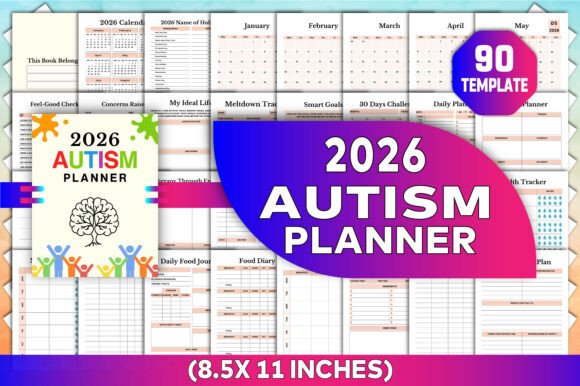
This isn’t a pre-printed physical book. It’s a high-resolution, ready-to-upload interior file package—PDF, JPG, and PNG formats—designed specifically for Kindle Direct Publishing (KDP). Every page is built in Canva, meaning it’s fully customizable: change fonts, colors, layout spacing, icons, even language or terminology to match your voice or audience. You get the original Canva template link upon download, so no design skills are required—you click, edit, export, and upload to KDP.
The content reflects lived experience: a “My Masking Behaviors” worksheet sits beside a “Unmasking Myself” reflection guide; a “Behavioral Trigger Tracker” pairs with a “Feel-Good Checklist”; nutrition tools like a food diary and allergy log coexist with emotional supports like a “Meltdown Tracker” and “Coping Skills Plan.” Even practical elements—like the 2026 monthly calendar with official U.S. holidays—anchor daily use in reality, not abstraction.
Why Different People Reach for This Planner
For autistic adults navigating self-discovery: This planner meets people where they are—not as patients or students, but as experts of their own lives. A 32-year-old teacher recently diagnosed might use the “Understanding My Thoughts” prompts and “Autistic Traits Checklist” to gently map patterns over months. The “Past Behavior Evaluation” and “Daily Food Journal” help connect energy levels, meals, and emotional regulation without judgment. There’s no pressure to “fix” anything—just space to notice.
For creators and small publishers: If you publish on KDP, this interior saves dozens of hours. Instead of designing from scratch—or licensing restrictive templates—you get an original, inclusive, SEO-aligned interior that stands out in search results for terms like “autism planner 2026” or “neurodivergent journal KDP.” Because it’s Canva-based, you can quickly adapt it for niche audiences: add ASL glossary pages for Deaf autistic users, simplify language for teens, or translate sections for bilingual families—all while keeping the core structure intact.
For educators and therapists (using ethically): While not a clinical tool, many professionals use this planner as a collaborative resource—especially when supporting clients who want autonomy over their planning process. A speech-language pathologist might print select pages (“Effective Communication,” “My Friendships”) to use in sessions, then let the client customize them at home. The emphasis on choice—“Things To Avoid,” “To Remember,” “Priorities”—supports person-centered care far more than rigid behavior charts ever could.
How Priorities Shift Across Use Cases
Ease of use matters most to beginners—so the Canva integration is key. No software installs, no learning curve beyond basic drag-and-drop. But for experienced designers, flexibility is the draw: layer masks, swap SVG icons, adjust bleed settings for perfect KDP margins. Quality shows in subtle ways—the health tracker uses consistent color logic (green = stable, amber = variable), the weekly planner leaves room for both appointments *and* sensory notes, and the “30 Days Challenge” page avoids vague prompts like “be kind to yourself” in favor of concrete, adjustable actions (“Today I paused before replying in a group chat”).
For business owners evaluating this for resale, commercial value lies in differentiation. Most autism planners focus only on routines or emotions. This one bridges practicality and identity—nutrition tracking *alongside* masking reflection, goal setting *alongside* meltdown analysis. That duality attracts readers searching for “autism life planner,” “ADHD and autism hybrid planner,” or “neurodivergent productivity tool.” And because it’s editable, you can test versions: one with minimal text for low-spoon days, another with expanded journaling space for deeper processing.
Real-World Use Examples
- A freelance writer uses the “Smart Goals” and “Goal Action Plan” pages to break down book deadlines—not by hours, but by energy type (e.g., “draft intro when sensory load is low,” “edit conclusion after rest”). They add custom icons in Canva to signal focus modes.
- A parent of a 25-year-old autistic adult adapts the “Health Record” and “Nutrition Tracker” to include medication timing and stim-friendly snack ideas—then prints double-sided, spiral-bound copies for shared use.
- A neurodiversity consultant buys the template, removes “This Book Belongs To” from the cover interior, and rebrands it as a client workbook—keeping all therapeutic frameworks intact but aligning visuals with their practice’s palette and tone.
- A college student uses the “Daily Checklist” and “Weekly Meal Plan” to manage executive function during finals week—while flipping to “Concerns Raised” to jot down classroom accommodations they’d like to request next term.
Does This Fit Your Needs?
If your goal is a polished, empathetic, adaptable KDP interior—and you value accuracy over aesthetics alone—this fits. It’s not for someone seeking minimalist design or strictly behavioral frameworks. It’s for those who understand that autism support includes honoring food preferences *and* thought patterns, tracking calories *and* coping capacity, planning meals *and* unmasking steps.
You don’t need Canva Pro—the free version handles all edits. You don’t need publishing experience—the PDF is KDP-optimized (CMYK, 300 DPI, proper bleed). And you don’t need to be autistic to benefit from its structure—many allies, partners, and caregivers find clarity in its balance of compassion and practicality.
The 2026 Autism Planner Canva KDP Interiors doesn’t promise transformation. It offers something quieter, and often more powerful: continuity. A place where 2026 isn’t just a date—but a year you meet yourself, again and again, with patience and precision.