2026 Bills Planner Canva KDP Interiors
Managing money doesn’t have to mean juggling sticky notes, mismatched spreadsheets, or forgotten due dates. The 2026 Bills Planner Canva KDP Interiors is a thoughtfully structured, fully editable interior designed for real-world financial clarity—whether you're launching your first self-published planner on Amazon KDP or building a custom budgeting tool for clients, students, or your own household.
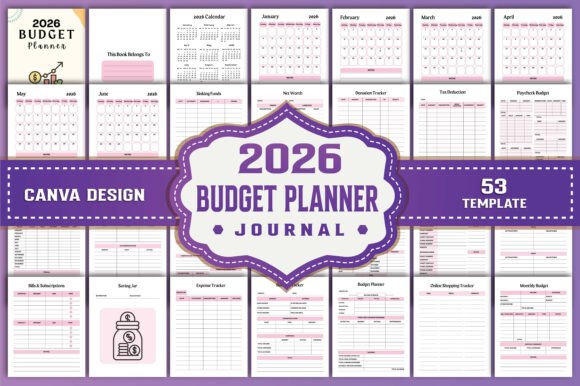
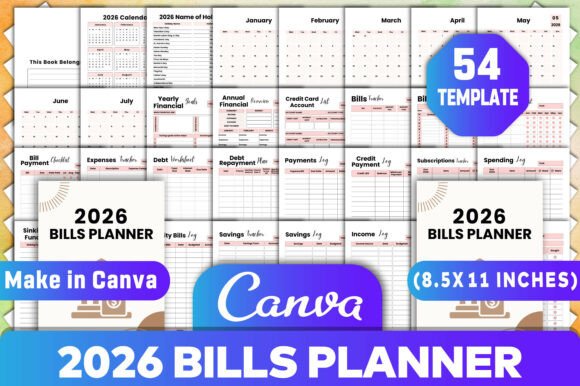
This isn’t a static PDF with locked text—it’s a living system. You receive an original Canva template link, 54 high-resolution pages (300 DPI), and print-ready files in PDF, JPG, and PNG formats—all sized to standard 8.5 x 11 inches. Every element—from the “This Book Belongs To” cover page to the detailed Debt Repayment Plan—is 100% customizable. No design degree required. Just open, adjust fonts, colors, icons, or layout order—and export.
Why This Interior Stands Out for Planners & Publishers
Most budget planners offer either oversimplified checklists or overwhelming complexity. The 2026 Bills Planner Canva KDP Interiors strikes a rare balance: comprehensive enough to support serious financial tracking, yet intuitive enough for beginners to adopt in under ten minutes.
It includes purpose-built sections like:
- Bills Tracker + Bill Payment Checklist (2 unique versions)—one optimized for visual scanning, another for handwritten notes and reminders.
- Sinking Funds Log + Savings Tracker—structured to reflect how people actually save: toward goals like car repairs, holidays, or insurance premiums—not just vague “future” categories.
- Credit Payment Log + Subscriptions Tracker—designed to surface hidden recurring costs, with space to note auto-renewal dates and cancellation status.
- Debt Worksheet + Repayment Plan—not just a list, but a step-by-step guide that helps users choose between avalanche vs. snowball methods, calculate payoff timelines, and log progress monthly.
Each section connects logically. The Monthly Planner flows into the Expenses Tracker, which feeds data into the Annual Financial Overview. Nothing exists in isolation—this is financial literacy made tangible.
Creative Applications Beyond Personal Use
Because it’s built in Canva and delivered as an editable source file, the 2026 Bills Planner Canva KDP Interiors becomes a launchpad—not just a finished product.
For KDP publishers: Swap out holiday names for region-specific observances (e.g., “Canada Day” instead of “Independence Day”), add bilingual labels, or integrate niche themes—like “Freelancer Finance” or “Student Budget Bundle”—without rebuilding from scratch.
For educators and coaches: Use the Wishlist and Bills Reminders pages to build classroom activities around delayed gratification and cash-flow awareness. Add reflection prompts (“What surprised you this month?”) directly into the Bills Notes section.
For small business owners: Repurpose the Income Log and Utility Bills Log to track client payments and operational overhead. Rename “Credit Card Account List” to “Vendor Payment Schedule” and adjust columns to include invoice numbers and net terms.
For designers and marketers: Treat the 54-page structure as a modular kit. Pull the Finance Tracker layout into a lead magnet. Isolate the Yearly Financial Goals spread as a social media carousel. Export individual pages as branded PNGs for email campaigns or Pinterest pins.
Practical Tips for Customization That Works
Customization is powerful—but only when it serves clarity. Here’s how to keep edits effective:
- Preserve hierarchy. Keep headers large and bold; use bullet points or checkboxes for action items; avoid stacking more than three font styles across the full planner.
- Color with intention. Assign consistent hues to categories: green for savings, red for overdue items, blue for income. Don’t add color just for decoration—use it to speed up scanning.
- Test spacing before printing. Canva’s drag-and-drop makes it easy to move elements—but tight margins or overlapping text can ruin readability. Always preview at 100% zoom and print one test page first.
- Localize thoughtfully. If adapting for international audiences, update date formats (DD/MM/YYYY), currency symbols, and tax-related fields—not just holiday names.
And remember: consistency builds trust. If you’re selling multiple planners, reuse core layouts (like the Bills Tracker grid or Debt Log table) across products. Your audience will recognize your design language—and return for reliability, not novelty.
Real-World Value, Not Just Aesthetic Appeal
A beautiful planner won’t lower your credit card interest rate. But a well-organized, consistently used one can. The 2026 Bills Planner Canva KDP Interiors supports behavior change—not through motivation, but through structure.
Example: A freelance graphic designer uses the Subscriptions Tracker to audit SaaS tools every quarter. Last month, she canceled two unused plugins and redirected $47/month into her “Emergency Fund” log. That’s not theory—that’s traceable impact.
Another user—a teacher planning a sabbatical—combined the Sinking Funds Log and Wishlist to break down a $3,200 travel goal into $267/month contributions. She set calendar alerts using the Bills Reminders page and checked off each deposit in the Savings Log. By November, she’d saved $2,912—and adjusted her December target to close the gap.
These aren’t edge cases. They’re outcomes enabled by thoughtful design: clear inputs, logical sequencing, and space for both data and reflection.
Getting Started Is Simpler Than You Think
You don’t need to master Canva to make this work. Start with one section—say, the Monthly Planner. Change the header font. Adjust the color of the “Due Date” column. Export as PDF. Print. Use it for one week.
Then revisit. Did you skip the Spending Log? Add a sticky note icon beside it in Canva next time. Did the Credit Payment Log feel too sparse? Insert a row for “Interest Rate” or “Minimum Payment.”
The strength of the 2026 Bills Planner Canva KDP Interiors lies in its responsiveness—not to trends, but to your actual habits. It grows with you. Adapts with your needs. And because it’s yours to edit, brand, and extend, it stays relevant far beyond 2026.
Whether you’re publishing on KDP, guiding clients, teaching financial wellness, or simply taking back control of your cash flow—the interior isn’t the end result. It’s the foundation you build on.