AI Project Planner – KDP Interiors
If you’ve ever stared at a blank Jupyter notebook, shuffled sticky notes across a whiteboard, or lost two weeks debugging a model only to realize your data pipeline was misaligned with the original goal—you’re not alone. AI projects fail more often from planning gaps than technical shortcomings. That’s where AI Project Planner – KDP Interiors steps in: a 120-page, field-tested PDF toolkit built not for theoretical ideation, but for real-world execution.
This isn’t another generic project management template repackaged with “AI” in the title. It’s purpose-built for developers, data scientists, academic researchers, and early-stage AI startups who need structure without bureaucracy—clarity without compromise. Whether you’re prototyping a customer sentiment classifier for your SaaS platform, designing an accessibility tool for educators, or building a fine-tuned LLM wrapper for internal knowledge retrieval, the AI Project Planner – KDP Interiors anchors every decision in intentionality and traceability.
What Makes This Planner Different?
Most AI planning resources either drown you in agile jargon or oversimplify complex trade-offs. The AI Project Planner – KDP Interiors avoids both traps by blending rigor with usability. Its strength lies in its sequencing: it walks you through phases *in the order you’ll actually experience them*, not how textbooks wish you would.
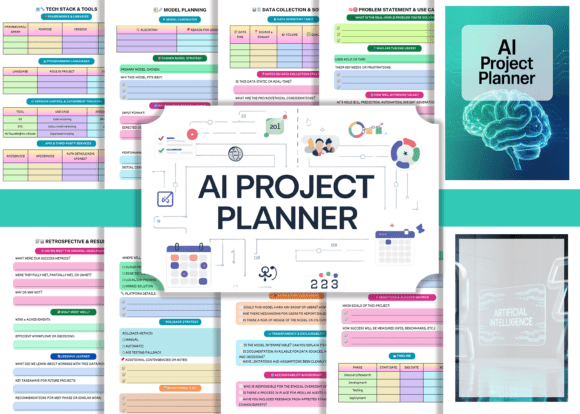
For example, the Problem & Use Case Definition section doesn’t ask, “What’s your problem statement?” It guides you to document: Who experiences this pain? How do they currently cope? Where does AI meaningfully augment—not replace—their workflow? That distinction keeps teams grounded when stakeholders start asking for “smarter” features that add zero user value.
Likewise, the Data Strategy Inventory goes beyond listing sources. It includes columns for provenance confidence (e.g., “Scraped from public forums — low consent transparency”), expected drift triggers (“Seasonal spikes in query volume may degrade label consistency”), and preprocessing debt tracking (“Requires anonymization before ingestion—estimated 4–6 hours”). These aren’t checkboxes—they’re conversation starters that prevent downstream rework.
Real Work, Real Environments
The versatility of AI Project Planner – KDP Interiors shines across contexts:
- Educators use it to scaffold capstone projects—students define ethics reviews before writing code, log dataset biases during literature review, and map model outputs directly to learning outcomes.
- Freelancers and solopreneurs treat it as a client-facing artifact: sharing annotated milestone trackers builds trust, while the Deployment Monitoring Plan helps set realistic SLAs around uptime, latency, and fallback behavior.
- Marketing teams building generative content tools apply the Tech Stack Tracker to audit API dependencies—knowing whether your image generator relies on a third-party service with rate limits (and potential cost overruns) before launch day.
- Nonprofits deploying AI for community impact use the Ethics & Bias Review framework to co-design fairness criteria with end users—not just internal teams—ensuring models reflect lived realities, not statistical averages.
It’s also quietly powerful for personal projects. A hobbyist training a birdcall classifier might skip formal validation logs—but the Training & Validation Logs section helps them spot when accuracy jumps from 72% to 89% after adding spectrogram augmentation, making experimentation deliberate rather than accidental.
Usability That Sticks
No planner works if it sits unused. The AI Project Planner – KDP Interiors succeeds because it’s designed for iteration—not perfection. Pages are printable, digitally fillable (PDF form fields included), and modular: you can complete the Project Overview and Milestone Tracker Gantt Chart in one sitting, then return later to flesh out model selection criteria as your understanding deepens.
The visual rhythm matters too. Clean typography, subtle color cues (blue for planning, green for validation, amber for risk flags), and consistent spacing reduce cognitive load. You won’t waste time decoding layout—you’ll focus on decisions.
Practical Considerations Before You Begin
Before downloading or assigning this to your team, consider three pragmatic factors:
- Team size and stage: It scales well—from solo builders to 5-person cross-functional squads—but becomes less efficient for enterprise programs with rigid PMO governance. If your org mandates Jira epics and quarterly OKRs, treat this as a complementary layer—not a replacement—for those systems.
- Technical depth: While accessible to non-engineers, some sections assume baseline fluency (e.g., understanding what hyperparameters like learning rate or batch size control). That’s intentional—it avoids diluting precision for the sake of broad appeal.
- Iteration mindset: The planner rewards honesty about uncertainty. Leaving a “Model Selection” cell blank is valid—if you note *why* (“Awaiting benchmark results on GPU-optimized inference backend”) and assign a due date, you’ve already done more than most teams.
Also worth noting: the Milestone Tracker + Gantt Chart isn’t auto-updating software. It’s a static, human-maintained timeline—designed so updates happen during weekly syncs, not via dashboard alerts. That friction is intentional. It forces alignment before progress is logged.
More Than a Document—A Discipline
Using the AI Project Planner – KDP Interiors consistently reshapes how teams think about AI work. You stop asking, “Did we train the model?” and start asking, “Did we validate the assumptions behind our success metrics?” You shift from celebrating deployment to auditing rollback readiness. You treat ethics not as a compliance gate, but as a design constraint—documented alongside data schema and API contracts.
That discipline pays off. Teams report cutting discovery-to-MVP cycles by 30–40%, reducing misalignment between product and engineering by clarifying scope *before* sprint zero, and improving stakeholder buy-in through transparent, shareable artifacts—not just status reports.
Ultimately, the AI Project Planner – KDP Interiors doesn’t promise faster AI—it promises fewer wasted sprints, clearer accountability, and projects that land with impact because they were built with intention from page one.