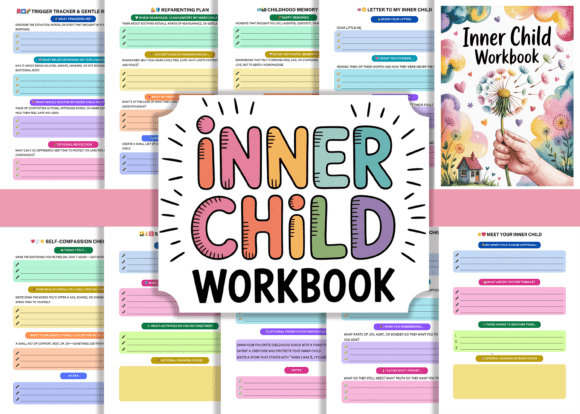
Inner Child Workbook – KDP Interiors
If you’ve ever paused mid-day and felt a quiet ache — a longing for safety, playfulness, or unguarded joy — you’re not broken. You’re carrying unmet childhood needs. The Inner Child Workbook – KDP Interiors meets that need with quiet precision: it’s not another self-help checklist or abstract theory. It’s a tactile, emotionally intelligent tool designed for adults who want to heal without overwhelm — and creators who need a polished, ready-to-publish interior that converts.
A Workbook Built for Real Life — Not Just Reflection
This isn’t a journal you’ll abandon after three pages. At 120 thoughtfully sequenced pages, the Inner Child Workbook – KDP Interiors balances structure with spaciousness. Each section flows like a compassionate conversation — not a clinical audit. You begin by naming your inner child (yes, literally giving them a name and age), then gently step into their world through visualization prompts and sensory grounding. That immediacy matters: it bypasses intellectual resistance and lands in the body first.
The 12 editable Canva pages are where practicality meets professionalism. Unlike static PDFs, these are pre-formatted for quick customization — swap fonts, adjust colors, insert your logo or brand voice — all without design experience. For KDP publishers, coaches, or therapists building digital products, this means launching faster, maintaining visual consistency, and scaling offers without redesigning from scratch.
What Makes This Interior Stand Out in a Crowded Niche?
Most inner child workbooks lean heavily into either therapy-speak or whimsy — neither fully serves the busy professional or the grounded creator. The Inner Child Workbook – KDP Interiors bridges that gap. Its tone is warm but never infantilizing; its visuals are soft and inviting (think muted earth tones, gentle line art, ample white space), not cutesy or cluttered. That aesthetic choice isn’t accidental — it signals emotional safety *before* the reader writes a single word.
Key differentiators include:
- Childhood Memory Map: Goes beyond “list three happy memories.” It guides users to locate sensory anchors — the smell of rain on hot pavement, the weight of a favorite blanket — helping rewire neural pathways tied to safety and belonging.
- Reparenting Plan: Moves past vague intentions (“I’ll be kinder to myself”) into actionable rituals — e.g., “When I feel criticized, I’ll pause, place a hand on my chest, and say: ‘You’re allowed to rest. I’m here.’” These are teachable, repeatable, and easily adapted for group coaching or classroom use.
- Trigger Tracker + Gentle Responses: Focuses on *response*, not just reaction. Users log triggers *and* co-create compassionate alternatives — turning insight into embodied practice.
Real-World Applications Across Roles
For Educators & Counselors: Use the Creative Expression Pages as low-pressure entry points for teens or adult learners exploring emotional literacy. The “Silly Childhood Story” prompt disarms defensiveness while building narrative agency — ideal for SEL curricula or trauma-informed classrooms.
For Creators & Marketers: The editable Canva pages let you rapidly A/B test covers, add lead magnets (e.g., “5 Reparenting Phrases You Can Use Today”), or localize content for niche audiences — therapists serving BIPOC clients, entrepreneurs recovering from burnout, or neurodivergent professionals rebuilding self-trust. Because the interior is print-ready *and* digital-friendly, one file serves Amazon KDP, Gumroad, Teachable, and email sequences.
For Freelancers & Small Business Owners: This workbook solves two pain points at once: personal healing *and* product development. Many service-based professionals hit capacity because they’re running on fumes — over-giving, under-nourishing, disconnected from their own creative spark. Working through the “Letter from My Inner Child” section often surfaces buried boundaries or forgotten strengths that directly inform business pivots, pricing shifts, or offer refinement.
Why Usability Matters More Than Ever
In a world of infinite scroll and fragmented attention, a workbook must earn its place on a shelf — or screen. The Inner Child Workbook – KDP Interiors prioritizes usability at every level: generous margins for left-handed writers, clear typography hierarchy, intentional page breaks between reflective and active sections, and zero ambiguous instructions. There’s no “interpret this symbol” or “fill in the blank however you like.” Instead: “Write one sentence your inner child needed to hear at age 7. Then underline the word that carries the most weight.” That specificity reduces friction — and increases completion rates.
Branding is subtle but strategic. The consistent use of soft blues and terracotta accents conveys calm and warmth without sacrificing sophistication. That cohesion builds trust before the first page is turned — critical for converting casual browsers into committed users.
Practical Considerations Before You Publish or Use It
If you’re evaluating this interior for your own KDP launch: check the bleed and trim settings (it’s optimized for standard 6x9” and 8.5x11” formats), verify font licensing for commercial use (all included fonts are embeddable and royalty-free), and test printing a sample chapter — especially the coloring pages — to ensure grayscale fidelity.
If you’re using it personally: start small. Don’t aim to finish in a week. Try one “Letter to My Inner Child” per month, or revisit the Trigger Tracker whenever a familiar emotional pattern resurfaces. Healing isn’t linear — and this workbook honors that truth in both content and pacing.
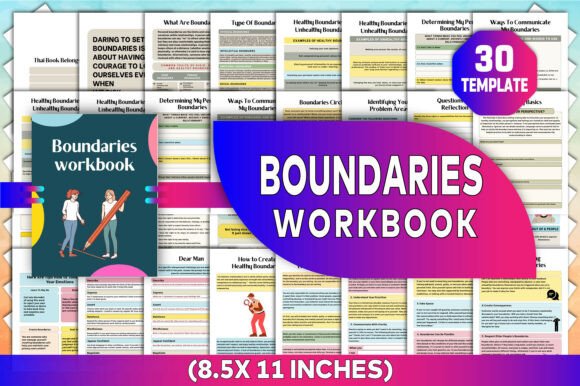
For teams integrating it into programs: pair the “Reparenting Plan” with accountability check-ins, not performance reviews. The goal isn’t productivity optimization — it’s sustainable presence. One wellness coordinator reported reduced staff turnover after introducing the workbook’s boundary exercises during quarterly retreats. Not because people worked harder — but because they finally felt *allowed* to stop.
The Inner Child Workbook – KDP Interiors works because it refuses to treat healing as a solo project or a luxury. It’s infrastructure — for quieter mornings, clearer decisions, bolder creative risks, and relationships rooted in earned safety. Whether you’re holding it for yourself or offering it to others, it meets you exactly where you are: tender, capable, and worthy of gentle return.