Self-Compassion Workbook – KDP Interiors
What if the most powerful tool for emotional resilience wasn’t found in a therapy office or a productivity app—but in a quiet moment with a pen, a printed page, and your own gentle attention? The Self-Compassion Workbook – KDP Interiors invites exactly that kind of grounded, human-centered practice. Designed not as a rigid curriculum but as a soft landing place for the overwhelmed, the self-critical, or simply the quietly exhausted, this 16-page printable guide meets people where they are—no prior experience required.
A Workbook That Begins With Belonging
Unlike many self-help resources that emphasize “fixing” or “optimizing,” the Self-Compassion Workbook – KDP Interiors starts from a radical premise: You are already enough—even when you’re struggling. Its foundation rests on Dr. Kristin Neff’s evidence-based model of self-compassion: self-kindness, common humanity, and mindfulness. But rather than defining these concepts abstractly, the workbook makes them tangible—through reflection, writing, and embodied choice.
Each page serves a purpose—not to fill time, but to create space. Space to pause before reacting. Space to notice judgment without being swept away by it. Space to remember that difficulty doesn’t mean failure—and that tenderness toward yourself is not indulgence, but skill.
What Makes This Workbook Different?
- No pressure, no perfection: There are no right answers—only honest responses. You don’t need to “get it right.” You only need to show up with curiosity.
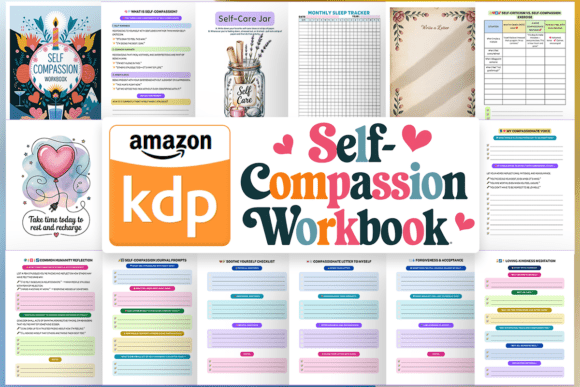
- Designed for real life: From the Self-Criticism vs. Self-Compassion Exercise to the Soothe Yourself Checklist, every feature responds to actual moments people face daily—like snapping at a loved one after a long day, canceling plans due to burnout, or lying awake replaying a perceived mistake.
- Printable + portable: As a KDP Interiors creation, it’s optimized for home printing—clean margins, minimal ink use, and soothing pastel accents that support calm (not visual clutter). Slip it into a notebook, keep it by your bedside, or tuck it into your work bag for micro-moments of grounding.
How People Are Using the Self-Compassion Workbook – KDP Interiors
This isn’t just for people in crisis—it’s for anyone who’s ever thought, “I’d never talk to a friend this way.” Here’s how different users integrate it meaningfully:
- Creatives & solopreneurs: Use the My Compassionate Voice section before sending a vulnerable pitch or launching a new offer—replacing “What if they hate it?” with “I’m learning, and that matters more than approval.”
- Managers & team leads: Adapt prompts like Common Humanity Reflections in 1:1 check-ins—not to fix an employee’s stress, but to normalize shared challenges and model psychological safety.
- Parents & caregivers: Flip to the Self-Care Jar when energy runs low—not as a luxury, but as essential maintenance. One parent wrote: “I cut out 12 ideas, laminated them, and pulled one each morning—even ‘drink water’ felt like grace.”
- Therapy clients & coaches: Assign select pages between sessions. The Self-Compassion Journal Prompts often surface insights faster than traditional journaling because they bypass analysis and invite embodied noticing (“Where do I feel tension when I think about this?”).
Real-World Strengths (and Honest Considerations)
The Self-Compassion Workbook – KDP Interiors shines in accessibility and intentionality—but clarity about its scope helps set realistic expectations:
- Strength: It’s lightweight, not watered-down. At just 16 pages, it avoids overwhelm while still delivering clinically grounded tools. Research shows brief, consistent practices (even 2–5 minutes daily) build neural pathways for self-compassion more effectively than infrequent deep dives.
- Consideration: It’s a companion—not a replacement. For those experiencing trauma, severe depression, or active crisis, this workbook complements professional support; it does not substitute for it. Its power lies in gentle reinforcement, not intervention.
- Strength: Built-in flexibility. The Monthly Sleep Tracker, for example, doesn’t demand perfect sleep hygiene. Instead, it asks: When I slept poorly, what was my inner voice saying? Did I respond with criticism—or care? That subtle shift reframes rest as relational, not transactional.
- Consideration: Requires willingness—not willpower. You don’t need motivation to begin. You only need a flicker of openness: What if I tried speaking to myself like someone I deeply love? That’s where the workbook meets you.
Who Benefits Most—And When to Pause
The Self-Compassion Workbook – KDP Interiors resonates especially with people who:
- Feel emotionally drained by constant self-monitoring or high personal standards;
- Struggle to access kindness during setbacks (e.g., job loss, health changes, creative blocks);
- Want to break cycles of comparison—especially in digital spaces where curated success feels ubiquitous;
- Are rebuilding after burnout and need permission to move slowly;
- Teach, counsel, or support others—and recognize their own compassion reserves are running low.
That said, there are moments when pausing the workbook is wise: during acute grief, dissociation, or when emotions feel physically unsafe. In those times, grounding techniques (like feeling your feet on the floor or naming five things you see) come first. The workbook waits patiently—no deadlines, no guilt.
Why “One Page at a Time” Isn’t Just a Tagline
The subtitle—💗 Self-Compassion Workbook – Be Kind to Yourself, One Page at a Time 🌸✨—captures its deepest ethic. Progress isn’t measured in completed pages, but in tiny ruptures of habit:
- Noticing shame rise—and choosing to place a hand over your heart instead of scrolling away;
- Writing “This is hard, and it’s okay to need help” in the My Compassionate Voice section—not as a platitude, but as a lifeline;
- Picking *one* item from the Soothe Yourself Checklist—not to “fix” the feeling, but to say, I see you, and I’m here.
Final Thought: Your Relationship With Yourself Is the First Project Worth Investing In
The Self-Compassion Workbook – KDP Interiors doesn’t promise transformation overnight. It offers something quieter, and perhaps more lasting: the repeated, gentle invitation to turn toward yourself—not as a problem to solve, but as a person to honor. Whether you’re navigating a major life transition, managing daily stress, or simply curious about what it feels like to meet your own humanity with warmth—the workbook holds space for that exploration. It doesn’t ask you to be different. It asks you to be kinder—to the one who’s been showing up, every single day, exactly as you are.